Loading...
Searching...
No Matches
ui Directory Reference
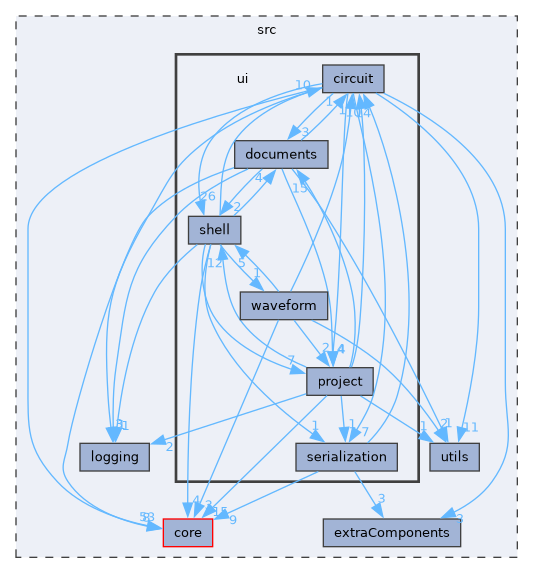
Directory dependency graph for ui:
Directories | |
| circuit | |
| documents | |
| project | |
| serialization | |
| shell | |
| waveform | |
Files | |
| actionGroups.hpp | |
| lifetime.hpp | |
Detailed Description
UI layout
- circuit/ owns the graphical circuit editor: components, diagram scene, routing, and editing controls.
- documents/ owns editors and views for project documents, including code, binaries, and ISA architectures.
- project/ owns the .sil project workflow, document tree, and project file actions. A project contains circuit JSON documents and may contain other document types.
- shell/ owns the main window, menus, dialogs, appearance, and application settings.
- waveform/ owns the waveform viewer and its window controller.
- serialization/ connects UI objects to document serialization and component registration.
The data models and .sil archive format live under src/core/.
Text annotations
Text components support *bold*, _italics_, and inline LaTeX math enclosed in $...$, for example Output: $y = \frac{a_1 + a_2}{2}$. Use \$ for a literal dollar sign. Empty or unmatched delimiters and invalid formulas stay visible as text. Formulas are rendered with JKQTMathText and participate in text wrapping and resizing. Saved annotations retain their original text and markup.
Ownership and callbacks
Qt parents own ordinary child widgets, layouts, and actions. Graphics scenes and parent items own their graphics items. Raw pointers to those objects are borrowed. Keep those ownership trees unless an object must be released before its parent or before other C++ state disappears.
Use value members or std::unique_ptr for independent and ordered ownership. Declare dependencies before their consumers: C++ members are destroyed in reverse declaration order. An explicitly owned Qt object may still have a parent for presentation, provided its C++ owner always releases it before that parent dies. Do not combine explicit ownership with WA_DeleteOnClose or deleteLater().
Use CallbackScope for connections that access derived-class or adapter state. Declare the scope after the state and owners those callbacks use. Its QObject context disconnects signals and discards queued deliveries before member or Qt child teardown begins. CallbackScope::guard() also protects callbacks retained outside Qt's signal system. A QMetaObject::Connection handle does not disconnect when it goes out of scope.
Dialog helpers accept an optional callback context independently of their widget parent. Supply the controller's context when a dialog can outlive its controller; otherwise the parent is the default callback owner. Event filters and browser listeners likewise need scoped registrations when their lifetime must end before their Qt owner is destroyed.
Default ordinary UI destructors where ownership and member order suffice. Keep custom destructors in resource owners that must unregister, synchronize, or finish framework interactions. WindowLifetime contains Qt's dock and toolbar drag cleanup so it runs while the main-window layout is still intact.